SpaceX and AI: The Next Market Frontier - New Era or Déjà Vu of 1999
17 June 2026
Key Takeaways
- The AI capital spending cycle is only about three years old, compared with the internet boom's roughly seven years, suggesting the buildout still has runway before it reaches the late-cycle exhaustion seen in 1999-2001.
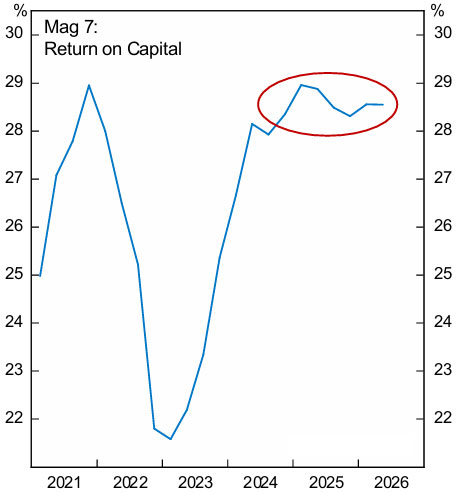
- In this cycle, capital returns and corporate margins for hyperscalers remain near record highs, with limited signs of the diminishing returns that busted the dot-com boom.
- Unlike the 1999-2000 rally, today's equity rally has been driven almost entirely by earnings growth rather than multiple expansion, leaving valuations comparatively disciplined even after years of gains.
- SpaceX's record-breaking IPO, with the company raising $75 billion at a market value near $2.2 trillion, shows public markets are already underwriting the next phase of AI-and-space infrastructure, even as sticky inflation keeps the Federal Reserve cautious.
The AI Capex Cycle: Still Early Innings
Hyperscalers have committed more than $600 billion this year alone to AI infrastructure. This amount of capex rivals the internet investment boom; however, the key difference here is duration, not amount. The current AI capex cycle is only three years old, while the 1990s buildout ran for roughly seven years before the burst.
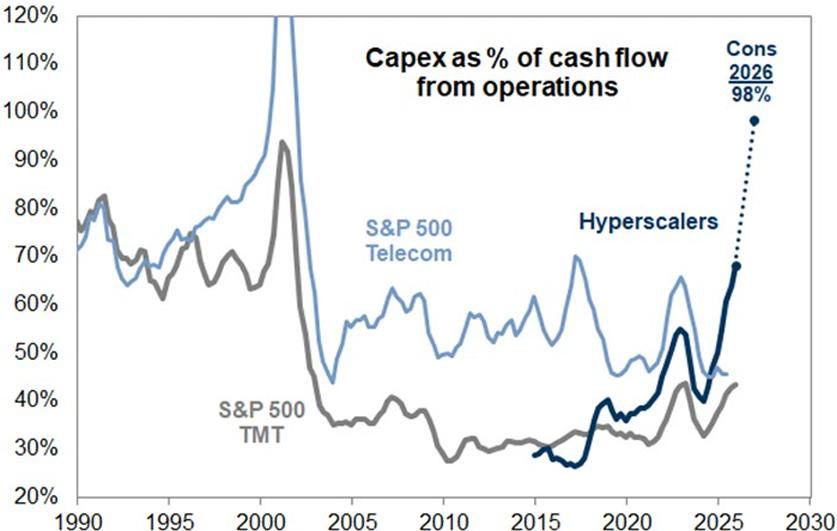
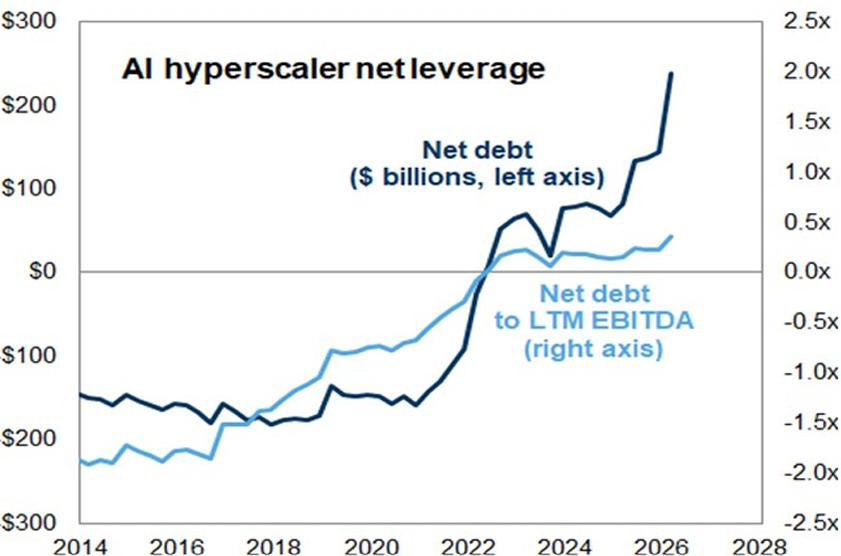
The spending so far is mainly concentrated among a handful of hyperscalers, who have largely funded this through the large amount of free cash flows these companies have been generating. Only recently have they tested the public debt & equity markets, and investors seems comfortable funding it, suggesting there is an increasing belief and appetite amongst for investors when it comes to such companies. Capital spending across the rest of the private economy remains subdued.
Crucially, there's no sign yet of the capital-return decay that doomed the dot-com cycle. Return on capital for the largest tech companies sits near cycle highs, unlike in 1997–2001, when profitability eroded well before the eventual bust. Today's binding constraint on hyperscaler investment looks like scarce compute, power, and cooling capacity, not excess supply.
SpaceX's Record IPO: The Theme Goes Vertical
If hyperscaler capex is the foundation of this cycle, SpaceX's recent initial public offering is its most visible new landmark. The company raised roughly $75 billion at $135 a share, closed its first trading day near $160, and emerged with a market value of about $2.2 trillion, the largest IPO on record. Even Elon Musk has admitted the company's success once seemed improbable, highlighting how far sentiment has shifted.
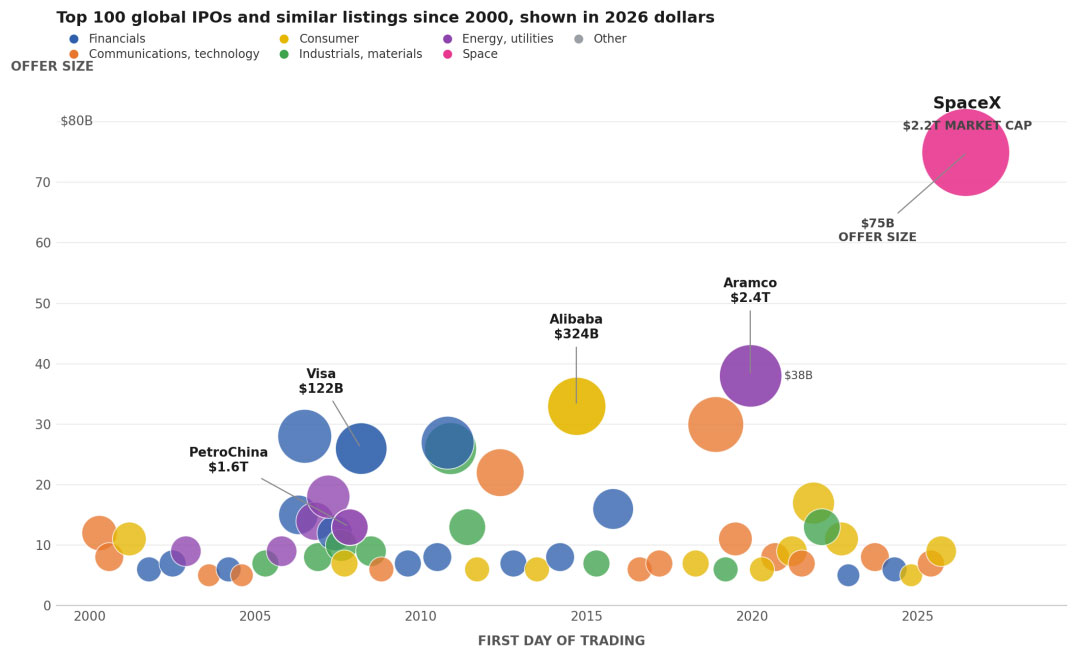
IPO itself is very interesting. It appears the company valuations are driven less by rocket-launch economics than by SpaceX's pivot into AI infrastructure, following its acquisition of xAI in February and an agreement to acquire the AI coding startup Cursor in April. Management has also floated the longer-term possibility of space-based data centres, which could draw on continuous solar power. Today, this looks like a speculative bet, but it shows how far investor imagination and willingness to pay can go: roughly 100x sales, with no clear path to near-term profitability.
Why SpaceX Matters
For the first time, SpaceX provides a real and viable opportunity to commercialise space at industrial scale. By driving down launch costs through reusability, it has redefined the economics of getting to orbit. In that sense, SpaceX is to space what leading AI platforms are to compute: the core enabler of a much larger ecosystem.
For the company, the opportunity extends beyond launches. If space becomes viable real estate for data centres, communications relays, and AI infrastructure, SpaceX becomes the gateway to that entire layer of economic activity. IPO’s success suggests that investors are already pricing in that optionality, well ahead of any clear revenue model.
Taken together, the SpaceX listing is evidence that the AI investment theme is broadening beyond chips and hyperscalers into adjacent infrastructure, launch capacity, and compute. And that public capital markets remain willing to fund enormous up-front spending in pursuit of that buildout.
What’s Different: Profits, Not Multiples, Are Doing the Work
The character of this bull market also differs sharply from its 1990s predecessor. Since 2021, the S&P 500 and its earnings have both roughly doubled, leaving the index's forward P/E ratio little changed. The pattern is even more pronounced in the tech-heavy Nasdaq 100, where forward earnings have nearly tripled to over 20% annually over the past year. At the same time, the forward multiple has actually been compressed by roughly a fifth versus its 2021 peak.
Impressively, the earnings of the growth segment of the market have risen by over 150% over the past five years, leaving valuations cheaper today than five years ago.
Back in the late 90’s, S&P 500 earnings doubled but share prices tripled, pushing the forward multiple from roughly 13x to north of 25x. The rise if growth stocks were the most extreme, where prices in some cases rose nearly 400% with no earnings growth, taking valuations toward 60x at the 2000 peak. In other words, the dot-com bubble was almost entirely a multiple-expansion story; today's rally has been almost entirely an earnings story.
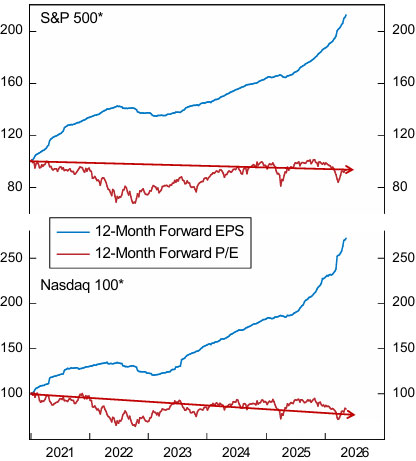
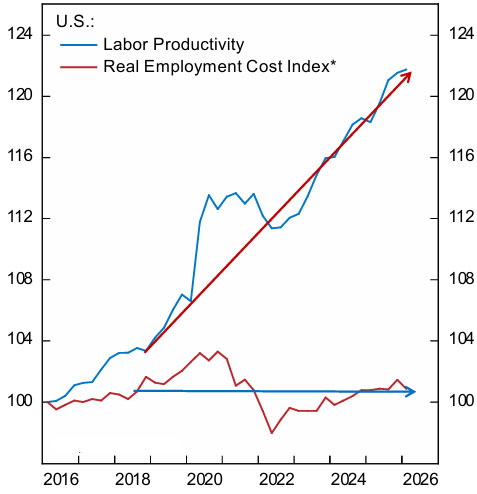
Two macro forces explain the divergence. First, the 1990s combination of disinflation and Fed easing fuelled a re-rating of equities that today's sticky-inflation, range-bound-rate environment has simply not allowed; the market has instead traded close to the multiple a standard Fed-model valuation framework would imply given current bond yields. Second, AI's productivity gains appear to be flowing overwhelmingly to corporate profits rather than labour. Real worker compensation has been essentially flat for more than a decade, even as productivity and corporate profits have surged. This, we believe, is a far more "pro-profit" distribution of the technology windfall than in the 1990s, when productivity and real wages rose together.
Inflation Remains a Swing Factor
All told, the inflation backdrop remains mixed after the recent oil price surge. Core PCE estimates were revised higher following the latest CPI/PPI prints, with May likely hitting a fresh cycle high of 3.4–3.5%, driven by a 7% jump in gasoline plus gains in electricity, tobacco, and airfares.
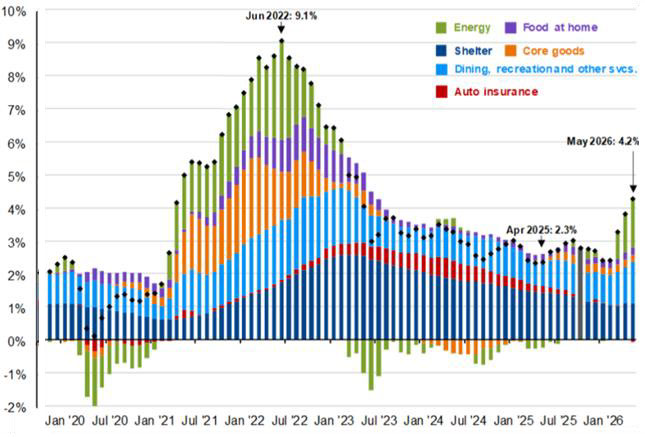
However, oil prices have already retreated from its May peak (a favourable base effect), and housing and services remain disinflationary. Shelter, a third of the CPI basket, should ease gradually as rental data and vacancy rates (highest since 2017) point to softer conditions through 2027. Wages add little pressure: average hourly earnings rose just 3.45% in May, a five-year low, with real wages falling for two straight months amid weak union power. Net result: CPI should fall to 3.3% by December and stabilise near 2% through 2027.
This distinction matters for how the cycle evolves. We see equity valuations as fair, not stretched, without the mania hallmarks of the late 1990s, though a sustained decline in inflation and rates is still the missing ingredient. If inflation stays sticky and the Fed holds or hikes, markets could wobble, but that's unlikely to derail the bull market given valuation headroom and nominal growth still supporting earnings.
The bigger upside case for us is if AI productivity gains prove real and structurally disinflationary, and / or if bond yields, which have tracked oil prices since the US-Iran conflict began, fall alongside oil prices, that could spark a much sharper re-rating , especially within the growth equities than seen so far this cycle. Separately, new Fed Chair Warsh, may look past the May inflation peak, trim projections, and open the door to rate cuts later in the year, as oil prices retreat. Of course, conveniently ahead of the November midterm elections. With energy easing and shelter softening, expect him to flag two-way risk in the coming months as growth and inflation cool into 2027. All is a constructive backdrop for risk assets through the rest of 2026.
Conclusion: Early-Stage Bull Market, Not Yet a Bubble
A capital spending cycle that is still in early stages compared to the past booms, capital returns and margins remain near highs and visible, relative to the past. The rally is built on fundamental earnings rather than multiples (unlike 2000). We believe that a record-setting capital markets event in SpaceX all points toward a bull market that is still in its earlier stages rather than its final, manic phase. There are still areas within the AI ecosystem, such as software and select hyperscalers, which we believe are underappreciated by the market. (Check out Wealthfusion Investment Outlook & Ideas for June 2026 for more on this).
No doubt that the near-term risks are real, inflation is not cooperating, and a Fed forced to stay restrictive could produce volatility along the way. But the bigger asymmetry sits on the other side: a genuine break lower in inflation, whether from AI's own productivity effects or from lower oil prices, would remove the one constraint, we believe, that is currently holding valuations in check.
Disclaimer
This is a marketing communication for information only and is not investment advice or a recommendation. We are not responsible for decisions made solely on this material. Any figures are subject to change and may be based on assumptions that can change. If performance is shown, it is net of fees unless stated. Investors are reminded that past performance is not a reliable indicator of comparable future returns, and an investor may not get back the amount original invested. The value of investors' capital and income derived from it is subject to fluctuation and therefore, there is no guarantee that the future value of the investment will exceed the original capital invested. This document should not be relied upon as being an impartial or objective assessment of the subject matter and does not constitute independent investment research for the purposes of Conduct of Business Sourcebook ("COBs") issued by the Financial Conduct Authority ("FCA") to reflect the requirements of the UK retained version of Regulation 600/2014/EU (the MIFID II Regulation") and the UK retained version of Director 2014/65/EU (the MIFID II Director") and all rules made in connection therewith (together, knowns as MIFID II"). The individuals who prepared this document may be interested in shares in the company concerned and/or other companies within its sector. As a consequence, any research (a has not been prepared in accordance with legal requirements designed to promote he independence of investment research under MIFID II; and (b) is not subject to any prohibition on dealing ahead of the dissemination of investment research (although WealthFusion Limited does impose restrictions on personal account dealing in the run up to publishing research as set out in our Conflicts of Interest Policy. This document should not be construed in any circumstances as an offer to sell or solicitation of any offer to buy any security or other financial instrument, nor shall it, or the fact of its distribution, form the basis of, or be relied upon in connection with, any contract relating to such action. This document has no regard for the specific investment objectives, financial situation, or needs of any specific entity. WealthFusion Limited and/or connected persons may, from time to time, effect transactions in any investment or related investment mentioned herein and may provide financial services to the issuers of such investments. The information contained herein is based on materials and sources that we believe to be reliable; however, WealthFusion Limited makes no representation or warranty, either express or implied, in relation to the accuracy, completeness, or reliability of the information contained herein. Opinions expressed are our current opinions as of the date appearing on this material only. Any opinions expressed are subject to change without notice, and WealthFusion Limited is under no obligation to update the information contained herein. None of WealthFusion Limited, its affiliates, or employees shall have any liability whatsoever for any indirect or consequential loss or damage arising from any use of this document. Nothing in this document excludes or limits any duty or liability we may have to you under applicable law or the FCA Rules (including liability for fraud or fraudulent misrepresentation). Neither this document, nor any copy or part thereof, may be distributed in any other jurisdictions where its distribution may be restricted by law, and persons into whose possession this document comes should inform him or herself about and observe any such restrictions. Distribution of this document in any such other jurisdictions may constitute a violation of securities law in the United Kingdom, the United States (or any part thereof), or any other jurisdiction in any other part of the world. The methodology and underlying assumptions used to either evaluate a financial instrument or an issuer shall, where relevant, be included (with information as to where any more detailed information can be found) in the substance of this note. Investments in general involved some degree of risk, including the risk of capital loss. The services, securities, and investments discussed in this document may not be available to or suitable for all investors, investors should make their own investment decisions based upon their own financial objectives and financial resources and, if in any doubt, should seek advice from an investment advisor. Where investment is made in currencies other than the investor's base currency, movements in exchange rates will have an effect on the value, either favourable or unfavourable. Levels and bases for taxation may change. An investor should only invest if he/she has the necessary financial resources to bear a complete loss of the investment value. Prior to authorising an investment, clients should carefully read all information provided by the Relationship Manager and/or the Investment Management Team of WealthFusion Limited. Portfolio holdings and/or allocations shown are as of the date indicated and may not be representative of future investments. The holdings and/or allocations shown may not represent all of the portfolio's investments. Future investments may or may not be profitable. This material is private and intended solely for the addressee. You may share it with your professional advisers (eg, accountant, tax, or legal adviser). Please do not otherwise copy, forward, or publish it without our consent. This document has been issued by WealthFusion Limited, which is authorised and regulated by the Financial Conduct Authority (Firm Reference Number: 914259). Unless otherwise stated, WealthFusion Limited owns the intellectual property rights and any other rights in this document. Neither the whole nor any part of this material may be duplicated in any form or by any means. Neither should any of this material be redistributed or disclosed to anyone without the prior consent of WealthFusion Limited.
Discover Similar Insights
Every day, our experts deliver fresh insights on trending topics,
sectors and markets to help you stay ahead of the curve.

Worthwhile planning now to slash your inheritance tax
Talking to family members about your plans may be uncomfortable, but doing so helps avoid issues and disputes later on Attempting to plan what should happen to…

Gulf Energy Rebuild: Who Benefits from the LNG Repair Cycle
A Reconstruction Cycle in the Making The USIsraelIran war has left Gulf energy infrastructure vulnerable. The joint strikes began on 28 February, followed by a…

Europe's Quiet Comeback
Why the Continent Could Outshine US Equities Can European Stocks Stay in the Lead? For investors, the Trump 2.0 administration's roadmap hasn't gone as planned,…

Global Markets & Economy Adjust to US Tariff Shock
What was Announced? President Trump has declared that import duties will be raised significantly. Beginning on April 5, all imports will be subject to a "baseli…